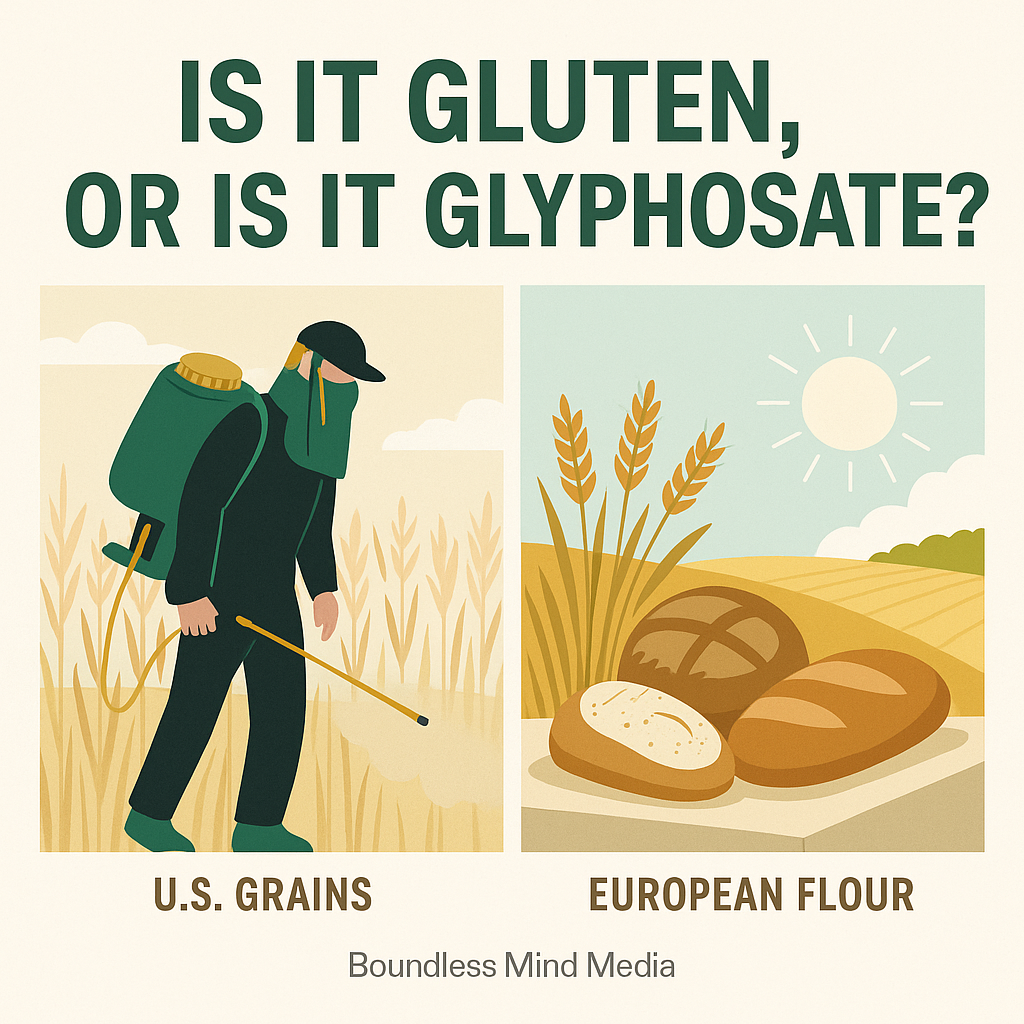
For years, I believed I was allergic to gluten. Like millions of Americans, I avoided wheat, oats, and other grains, convinced that gluten was causing my health issues. But a surprising discovery changed my perspective: when I eat bread in Europe — or even when I cook with imported Italian flour at home in America — I feel fine.
No hives. No inflammation. No pain.
So why does American bread and pasta leave me miserable, while European bread doesn’t? The more I paid attention, the more I realized it might not be gluten at all. It might be glyphosate.
My Symptoms: Not the Typical Gluten Intolerance
When most people talk about gluten sensitivity, they describe gastrointestinal discomfort — bloating, cramps, indigestion. That’s not my experience.
My body reacts differently. After eating wheat-based foods in the U.S., I develop hives on my scalp. More recently, I discovered something even more painful: a deep inflammation that settles into my lower back, causing excruciating pain.
This isn’t about my stomach — it’s a systemic reaction. But when I eat the same foods in Europe, or when I bake with imported Italian flour, these symptoms vanish.
That difference led me to question whether gluten itself is the problem, or whether something else — like glyphosate — is triggering my body’s response.
What Is Glyphosate and Why Does It Matter?
Glyphosate is the active ingredient in Roundup, one of the most commonly used herbicides in the United States. Farmers use it to kill weeds, but also as a pre-harvest treatment on crops like wheat, oats, legumes, and barley. This practice, known as “desiccation,” helps dry down the crop for easier harvesting.
The result? Glyphosate residues may remain on the food we eat.
In Europe, glyphosate use is far more restricted. Several countries have already banned or are phasing it out. Could this be why European bread and pasta are easier for many Americans to digest?
Why Do So Many Americans Go Gluten-Free?
The gluten-free trend has exploded in the last decade. Celiac disease, a true autoimmune reaction to gluten, only affects about 1 percent of the population. Yet surveys suggest that nearly 20 percent of Americans now reduce or avoid gluten altogether.
Are all of these people really gluten intolerant — or are they reacting to something else in American grains?
If glyphosate residues are causing inflammation, hives, digestive issues, or joint pain, then many Americans may be blaming gluten when the real problem is chemical exposure.
European Bread vs. American Bread
One of the most common questions in wellness circles is: Why does bread feel so different in Europe compared to the United States?
Some point to differences in wheat strains, with European flours often being lower in gluten content. But growing evidence and anecdotal experiences suggest that agricultural practices — specifically the use of glyphosate — may be a larger factor.
In my own life, the difference has been undeniable. I can eat bread, pasta, and pastries in Europe without symptoms. Back home, the same foods leave me with hives and inflammation.
Inflammation Beyond the Gut
Many people associate gluten sensitivity with GI issues, but reactions can look very different from person to person. In my case, it shows up as hives on my head and severe lower back pain caused by inflammation. Others report skin flare-ups, joint pain, fatigue, or brain fog.
The common thread is inflammation — but the trigger may not be gluten itself.
What You Can Do If You Suspect Glyphosate Sensitivity
I’m not a doctor, but through my personal experience, I’ve learned some practical steps that may help others who wonder if glyphosate is part of the problem:
- Experiment with imported flours, especially Italian or European varieties.
- Look for certified organic products, as they are less likely to contain glyphosate residues.
- Pay attention to how your body reacts when eating abroad versus at home.
- Keep a journal of symptoms to identify patterns.
- Explore alternative grains such as quinoa, millet, or rice that may carry less risk of glyphosate exposure.
Everyone’s body is different, but becoming aware of how food is produced — and how that impacts your health — can make a huge difference.
Raising Awareness Without Pointing Fingers
I don’t share my story to accuse farmers, food companies, or regulators. Farming is complex, and feeding large populations is no small task. But I do believe it’s worth raising the question:
Are many Americans living gluten-free not because of gluten, but because of glyphosate?
If so, then our health conversation needs to expand. Instead of demonizing gluten, a protein humans have consumed for thousands of years, maybe we should be looking harder at the chemicals surrounding our food supply.
Final Thoughts: It Might Not Be the Gluten
For me, gluten-free isn’t really about gluten at all. It’s about glyphosate. The hives, the inflammation, the lower back pain — they’ve all been tied to eating grains grown in the U.S. But when I eat in Europe, I don’t experience the same problems.
That difference is too consistent to ignore.
The next time you hear someone say they’re gluten-free, it’s worth asking: Is it really the gluten, or is it glyphosate?
Because if it’s not the gluten, then the way we look at food, farming, and health in America may need to change.
– Kurt TeWinkel/Boundless Mind Media